 Ghanawatchonline.com News, Politics, Education & More
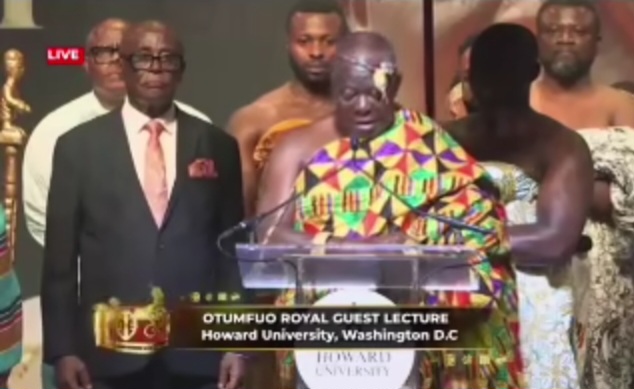
Asantehene Otumfuo Osei Tutu II has called for cultural preservation to be made an integral part of Ghana’s educational policy, warning that the neglect of indigenous languages, traditions and knowledge could deprive future generations of an important understanding of their identity and the world around them.
He said cultural preservation must not be treated merely as an occasional celebration of traditional festivals or heritage but should become a deliberate and sustained component of the country’s education system.
“Cultural preservation must become part of serious educational policy,” the Asantehene said.
Otumfuo made the remarks at the Otumfuo Royal Guest Lecture at Howard University in Washington, D.C., where he spoke on culture, institutions, morality, leadership and the responsibility of society to preserve knowledge for future generations.
According to the Asantehene, the loss of an indigenous language goes far beyond losing a method of communication because languages carry unique ways of interpreting reality, expressing values and understanding human relationships.
He explained that in Ghanaian traditional culture, proverbs, appellations, songs, court language and oral traditions contain ideas and meanings that cannot always be fully translated into another language without losing some of their original significance.
“When a language disappears, humanity does not really lose a method of communication. Humanity loses a distinctive way of understanding the world,” he said.
Otumfuo said indigenous languages serve as repositories of history, philosophy, ethics and collective memory, making their preservation important not only to particular communities but to humanity as a whole.
He therefore raised concerns about the number of children who can still speak the languages of their grandparents fluently and understand the deeper meanings contained in traditional expressions.
The Asantehene questioned how many young people today could explain the histories of their towns, villages and families, or properly interpret the symbols, proverbs and traditional narratives that once served as important tools for teaching generations about morality, responsibility, leadership and social conduct.
He said the gradual decline in the use of indigenous languages should be treated as a serious educational and cultural concern because once a language disappears, the knowledge embedded within it can also become difficult, if not impossible, to recover.
Otumfuo noted that traditional societies used oral traditions as important mechanisms for transmitting knowledge from one generation to another. Through stories, songs, proverbs, appellations, festivals and customary practices, children learned about their history, obligations to society and the values expected of responsible citizens.
He said modern education should therefore not create a disconnect between young people and their cultural heritage but should provide them with the opportunity to understand both the modern world and the cultural foundations from which their communities emerged.
The Asantehene called on universities, traditional authorities, museums, families, churches, community institutions and governments to work together to document endangered knowledge and preserve oral histories and cultural archives.
He said traditional authorities, in particular, have an important role to play in identifying and protecting knowledge held within communities before it is lost through the death of elders and custodians of tradition.
He also called for greater use of technology in preserving Ghana’s cultural heritage, saying modern digital tools provide opportunities to record voices, languages, stories, songs, ceremonies and indigenous knowledge that previously existed largely in human memory.
According to him, technology could enable communities to create digital archives that future generations could access for research, education and cultural learning.
He stressed, however, that preservation should not mean keeping culture frozen in the past. Rather, it should involve transmitting valuable knowledge and principles to younger generations in ways that remain relevant to contemporary society.
The Asantehene said education must therefore help young people appreciate where they come from while equipping them to participate effectively in an increasingly globalised world.
He noted that a strong connection to culture could provide young people with a sense of identity, belonging and responsibility, while also helping them understand the values that have historically held their communities together.
Otumfuo further urged policymakers to look beyond the conventional approach to education and recognise indigenous knowledge as an important part of national development.
He said Ghana’s cultural heritage contains knowledge and philosophies that can contribute to contemporary discussions on leadership, environmental stewardship, community responsibility, conflict resolution and social cohesion.
The Asantehene’s remarks also highlighted the importance of families in cultural transmission, stressing that parents and grandparents remain critical custodians of language, history and traditions.
He encouraged families to speak indigenous languages with children and share family histories and traditional knowledge with younger members before such information is lost.
He said the preservation of Ghana’s cultural heritage must consequently become a collective responsibility involving government, educational institutions, traditional authorities, families and communities.
Otumfuo maintained that a nation that loses touch with its language and cultural memory risks losing an important part of its identity.
He therefore called for deliberate policies and sustained investment in cultural education, documentation and preservation to ensure that Ghana’s rich heritage remains accessible to future generations.
The Asantehene’s message ultimately underscored the need for Ghana to build an education system that does not only prepare young people for the future but also connects them meaningfully to the history, languages, values and knowledge of the people who came before them.
Source: ghanawatchonline.com

Samuel Sarkodie is a young journalist who has for years worked with Kumasi based OTEC FM as a news reporter and Time FM as a sports presenter, his versatility in the media fraternity has held him till date, he is always for the truth and accuracy in terms of news story. He is currently the Editor for this site, ghanawatchonline.com